Echoes Along the Columbia: A Story of Land, Change, and Belonging
The Columbia River Gorge is a landscape carved by cataclysmic Ice Age floods, and its modern contours have also been profoundly shaped by human intervention, displacement, development, and the pursuit of profit.
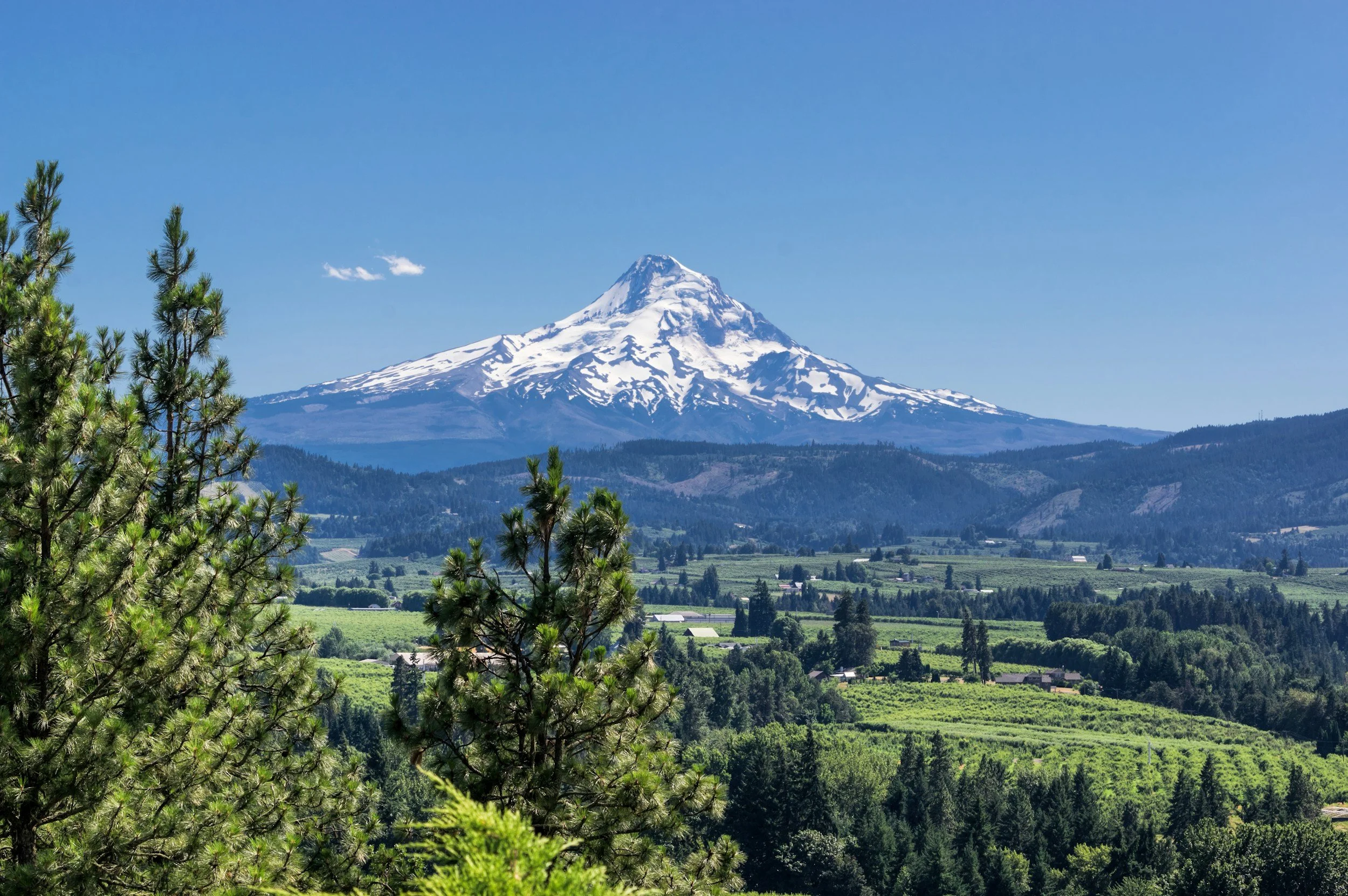
I arrived in the Gorge feeling called by Mt. Hood and the intersection of the elements in this geographic place. I wasn't coming for the weekend or simply looking for somewhere beautiful to visit. I came looking for a final place to land. Somewhere I could actually live, work, create, contribute, and become part of a community.
Something about this landscape immediately felt different to me. The mountains. The Columbia River. The sheer energy of the water and earth itself.
And almost immediately, I ran directly into the paradox of this place. There is extraordinary beauty here. There is also extraordinary difficulty in finding somewhere to live.
As I started learning more about the Gorge, I began wondering how those two realities became intertwined. And the deeper I looked into the history of the river, The Dalles, Celilo Falls, Hood River, tourism, and housing, the more I found myself returning to one question:
What does it mean to love a place without consuming it?
Part I: The Historic Floods of The Dalles
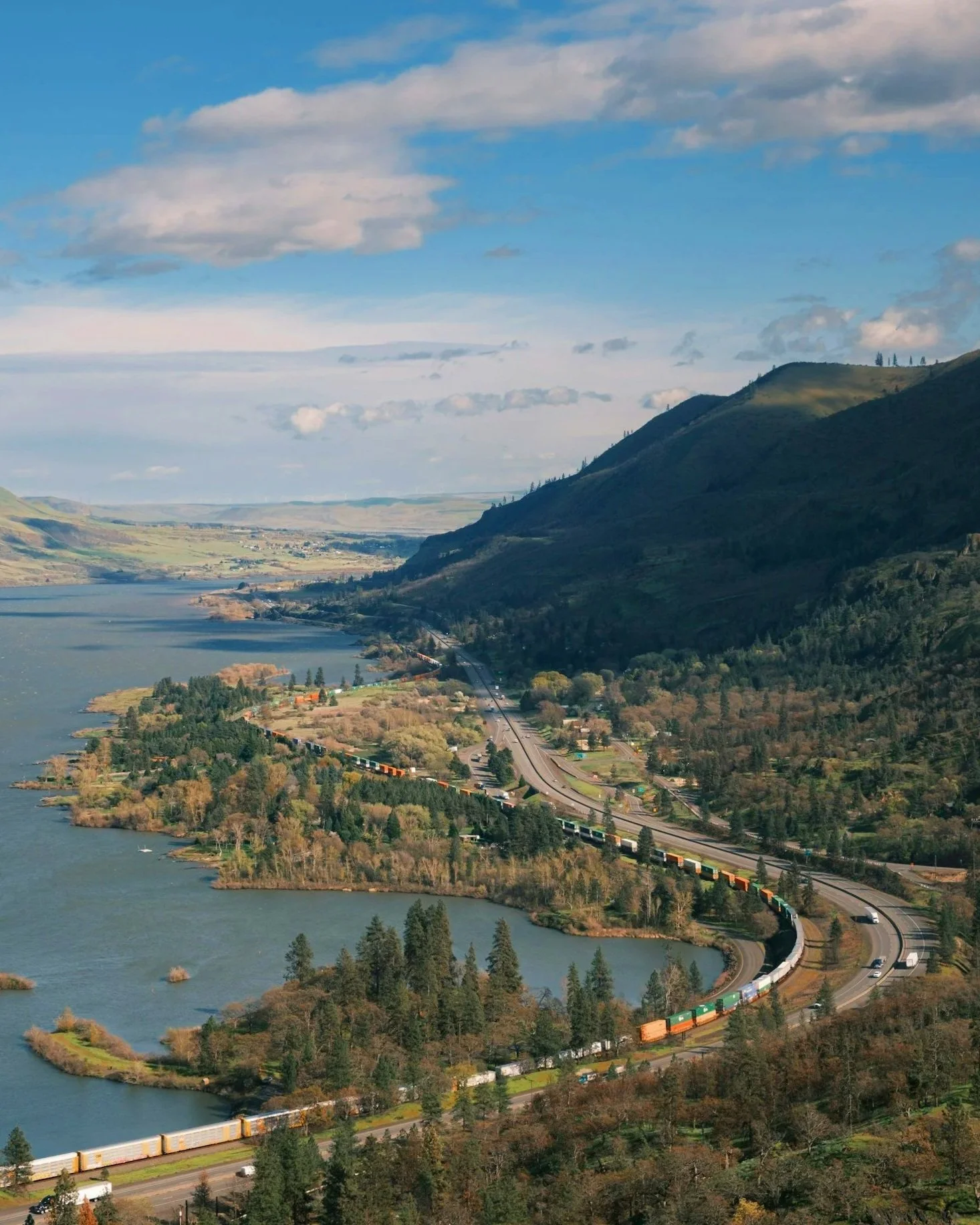
Long before asphalt and toll roads reached the Pacific Northwest, the site of modern-day The Dalles served as a critical place of human gathering, functioning as a vibrant Native American trading hub for thousands of years. The landscape was defined by the "Grand Dalles," a ferocious stretch of the Columbia River where fast water moved through narrow channels of columnar basalt rock. French-Canadian trappers in the early 1800s used the word "dalle," meaning a flat stone slab or gutter-like channel, to describe how the river rushed through these rocky troughs.
The End of the Overland Trail
For thousands of pioneers in the 1840s and 1850s, this rocky bottleneck marked the end of the overland portion of the Oregon Trail. Wagons could not navigate the steep basalt cliffs dropping toward the water. Emigrants faced a difficult choice: dismantle their wagons and brave the rapids on wooden rafts, or pay a toll to detour around Mount Hood via the rugged Barlow Road.
To manage the growing influx of settlers and conflicts with Native Americans, the U.S. Army established Camp Drum in 1850, later renamed Fort Dalles. Today, its preserved 1856 surgeon's quarters remain from that period of profound transition in the region.
The Inundation of Celilo Falls
Another enormous transformation of the river came in the 1950s when the U.S. Army Corps of Engineers constructed The Dalles Dam. Designed to generate hydropower and make the river more easily navigable for commercial traffic, the dam fundamentally altered the region's ecology.
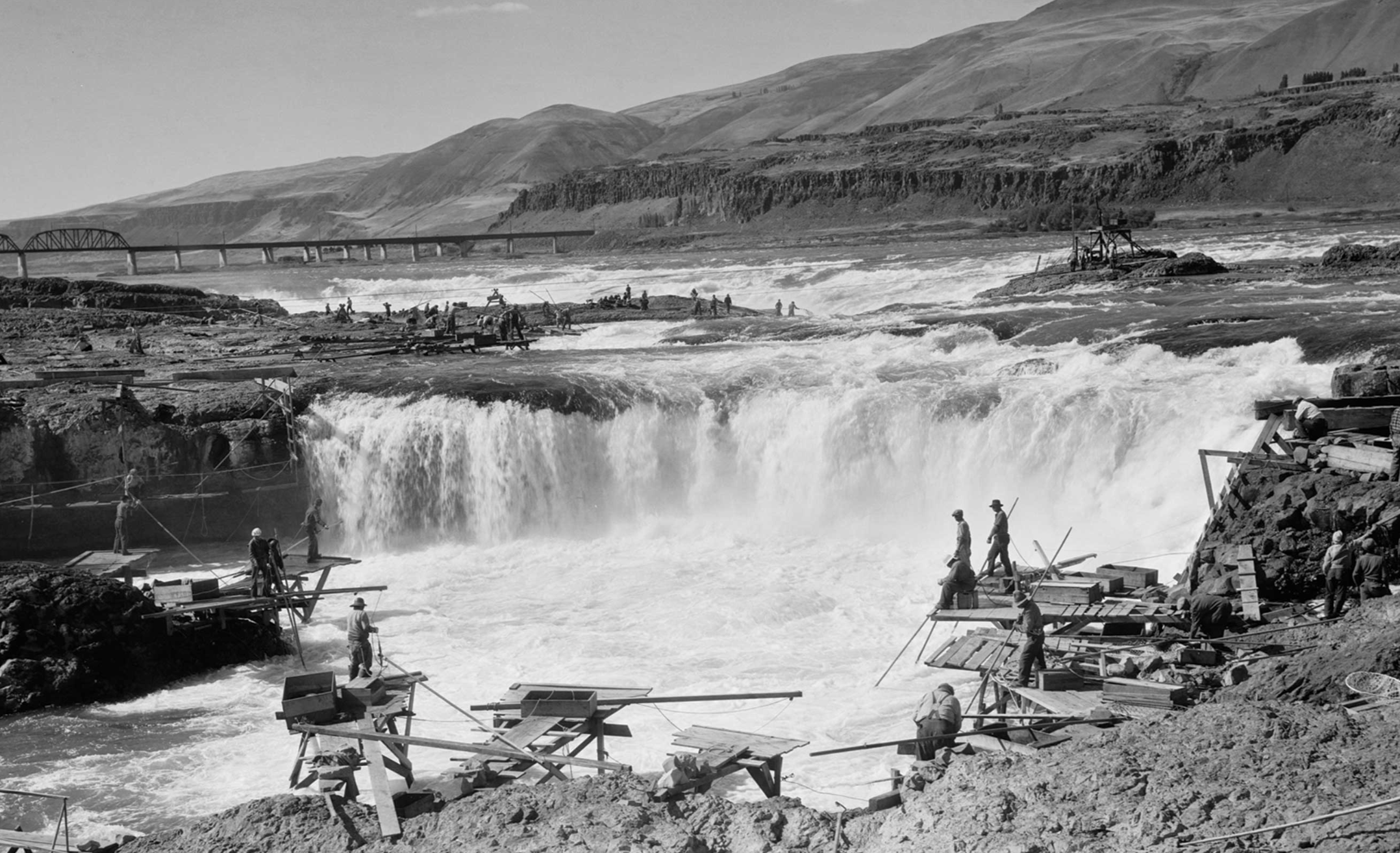
When the gates closed on March 10, 1957, the rising waters behind The Dalles Dam submerged Celilo Falls, or Wyam.
For thousands of years, Celilo Falls had been a spiritual, economic, cultural, and gathering center for Indigenous peoples throughout the region.
The impact extended far beyond the physical falls.
The river-dwelling peoples of the Columbia Gorge, including the Wasco, Wishram, Cascades, Wayám and Klickitat, experienced profound disruption to ancestral homes, fishing places, cultural sites, and ways of life.
The falls were also part of an enormous interregional trade network. Indigenous peoples traveled seasonal routes from across the Northwest and beyond to trade at Celilo, with salmon connecting communities economically and culturally across great distances.
Traditional leaders resisted the idea that financial compensation could replace what had been lost. The flooding changed far more than the geography of the river. It altered relationships among people, salmon, water, land, trade, ceremony, and place.
Learning this history while physically sitting beside the Columbia River, I felt the river’s energy. It wasn't simply beautiful scenery, it carried immense history.
Part II: The Modern Economic Pressure in Hood River
A few miles downriver, Hood River is navigating a very different kind of pressure today.
And this is where the history stopped feeling abstract to me.
I am currently trying to find housing here.
I have been moving through hotels and temporary spaces with my dog and cat while looking for somewhere we can actually settle. I've been talking with people, looking at rentals, interacting on social media community groups, driving through neighborhoods, and trying to understand what it actually takes to become a year-round community member rather than someone passing through.
What I discovered very quickly is that I am far from the only person struggling to find housing.
There is something strange about searching for a home in a place where there are clearly so many homes. I can scroll through beautiful places available for a few nights while struggling to find somewhere available to actually live. It has made the housing issue here tangible for me in a way statistics never could.
Hood River faces unusual geographic constraints. The Columbia River sits to the north, agricultural land surrounds much of the area to the south, and development throughout the Gorge is affected by protections associated with the Columbia River Gorge National Scenic Area.
Housing supply is therefore complicated in ways that aren't immediately obvious when you arrive here as a visitor. At the same time, Hood River is an extraordinarily desirable tourism destination. Vacation homes, second homes, short-term rentals, rising property values, limited housing inventory, and the economic benefits of tourism all collide within a relatively small community.
And suddenly I found myself thinking about the difference between visiting a beautiful place and belonging to one.
Tourism brings real economic benefits. People come here because the Gorge is extraordinary. They eat in restaurants, shop in local businesses, stay in lodging, hire guides, attend events, and support an economy that many local people depend upon. But there is another side to that equation.
When homes increasingly function as investments, vacation properties, or temporary lodging rather than places where year-round residents live, the people required to sustain a community can have a harder time remaining inside it.
Teachers. Restaurant workers. Artists. Healthcare workers. Farm workers. Therapists. Small-business employees. Families. People trying to become neighbors.
That tension fascinates me because it raises a larger question about community:
At what point does loving a place begin to change the very thing we came there to experience?
Part III: Hood River's Response
Hood River has attempted to address some of these tensions through regulations governing short-term rentals. The city's approach has included residency requirements for certain short-term rentals in residential zones, an effort intended in part to preserve housing for people who actually live within the community.
Those regulations have also generated legal challenges from property owners who argue that residency restrictions unfairly limit how they can use their property.
That conflict captures something much larger happening in desirable communities around the country.
Who gets to live somewhere?
Who gets to profit from somewhere?
What responsibilities come with owning property in a place where other people are struggling to remain?
And what responsibility does a community have to protect its ability to remain a community?
Part IV: What Repair Could Look Like
This housing crisis echoes something much older in the history of the Gorge: the westward movement of the 1800s, when settlers arrived seeking land and opportunity while Native peoples were displaced from land they had inhabited and stewarded for generations.
The history of Celilo Falls and the contemporary housing pressures of the Gorge are profoundly different experiences. Yet learning about them beside one another has made me think deeply about the patterns that can emerge when a place becomes desirable to those coming from somewhere else: extraction, displacement, stewardship, belonging, and reciprocity.
It has also made me curious about what repair looks like when it is defined by the Indigenous nations whose relationships with this river extend back thousands of years. That includes listening to tribal leadership around housing, treaty rights, salmon recovery, water management, cultural sites, land stewardship, and sovereignty.
There are also questions worth asking about where the enormous amount of money generated by tourism in the Gorge ultimately goes.
Could more of it support permanent housing?
Could tourism and short-term rental revenue contribute more directly to the communities and Indigenous nations whose land, labor, culture, and stewardship make this place what it is?
Could loving a place include taking responsibility for our impact on it?
The Persistent Paradox
I came to the Gorge because I was called here, and when I arrived I immediately felt something here.
And I know I'm not the only one. People travel across the world looking for places that still feel alive. Mountains. Rivers. Forests. Small towns. Places where nature is still powerful enough to interrupt us.
But perhaps the invitation isn't simply to find those places. Maybe it is to learn how to enter them differently.
I am still looking for my own place here. I'm still learning this community, this landscape, and its history. I don't have a neat answer to any of this. But being here has changed the question for me.
I don't only want to ask: Where do I want to live?
I want to ask: How do I want to live in relationship with the land and ultimately this place that holds me? Because perhaps belonging isn't simply finding a beautiful place and claiming a piece of it.
Perhaps belonging begins when we become invested in whether the people, animals, water, land, and communities already there can continue to thrive too.
Reciprocity feels like one of the biggest conversations of this time, across so many layers of our lives: what we take, what we give, how we participate, and how we care for what holds us.
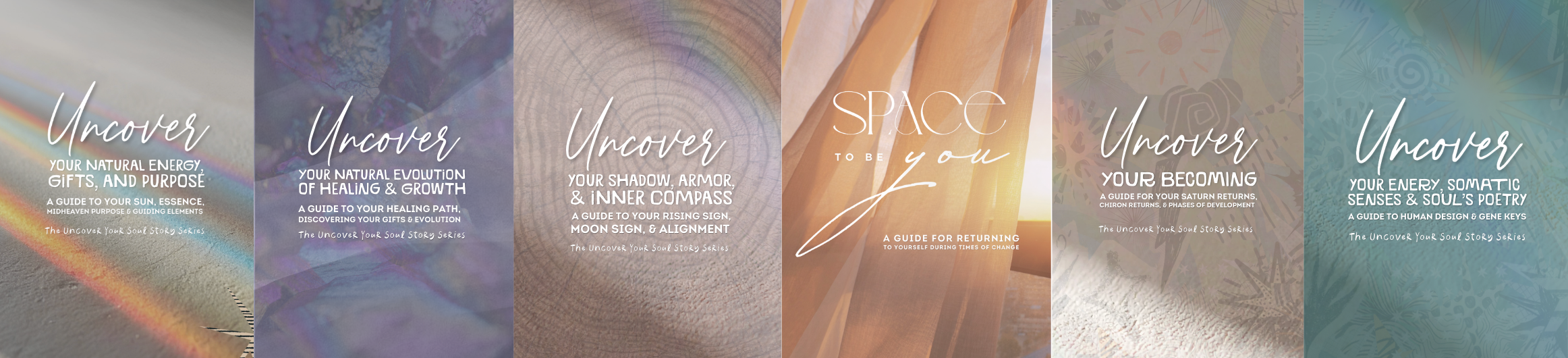
Uncover Your Natural Evolution is an introduction to understanding your healing path, how you grow and evolve.
Uncover Your Natural Gifts & Purpose is an introduction to understanding your soul purpose through astrology and embodied self-discovery.
Space to Be You is a companion for times of change, transition, and the in-between, offering reflections and practices to help you reconnect with yourself as life unfolds.
Other guides can be found here, Human Design and Gene Keys will be live in September 2026.
Book a Transmission Reading: When you book an hour of time is blocked out on my calendar to pull your charts, create a 20 minute recorded reading of your charts and finally do an oracle card pull from my unpublished decks to seal your reading.
Whether you're experiencing an awakening, navigating a major life shift, or simply longing for greater depth and alignment, these guides and readings are designed to meet you where you are. There is also a bundle of ll 3 guides flipbook style for a discounted rate here.
I am working on guides for Human Design and Gene Keys now if you are interested in exploring what they have to show you about your energy, body, and intuition and how they can work together to support you. Uncover Your Natural Gifts & Purpose is a great place to start.
Exploration & Live Integration
Sometimes the most meaningful shifts happen after the insight arrives.
My 1:1 Exploration & Live Integration sessions are for those who have completed one of the guides or are aligned existing clients. Together, we'll explore what has surfaced, integrate the wisdom into everyday life, and, when helpful, use mindfulness, energy healing, your Astrology, Human Design, Gene Keys charts, and current life experiences to uncover your next steps with greater clarity and alignment.
*Integration live sessions can be booked after a Transmission Reading or you complete a guide.